
How to Choose the Right Commercial Roofing Contractor for Large Buildings: Part 1 of 2
Essential questions to ask, red flags to avoid, and what separates exceptional contractors from the rest. Based on industry research, Google review analysis, and decades of commercial roofing experience.

Choosing the right commercial roofing contractor for large buildings requires more than comparing total years in business. Here's your checklist.
🔲 Don't default to “experience” as your primary criteria, 40 years of installing expired materials is worthless
🔲 Verify crew motivation and work ethic. Will they show up and perform, or are they slugs turning in 3 hours of focus per 8-hour shift?
🔲 Research material factory ratings (lab data, fire tests, chemical resistance), not just sales pitches from old supply lines
🔲 Demand labor transparency. Itemized hours, pay rates ($22-28/hr W-2 workers, not $15 cash illegal labor), and timeline breakdown
🔲 Evaluate product knowledge. Do they understand modern liquid coatings and vinyl vs expired plastic (TPO) and rubber (EPDM)?
🔲 Legal review of warranty. Plug the loopholes with your lawyer, eliminate fluff language (download comparison at yourwarrantysayswhat.com)
🔲 Track communication record. Check Google reviews for responsiveness, not just star ratings.
🔲 Understand true net margins. 8 to 15% is realistic, below 8% means they won't prioritize your project
Most contractors “go skinny to win”, low balling bids then bleeding you with change orders. Others drop 10% of materials to claim territory, then delay for months. Download our contractor evaluation scorecard to compare apples-to-apples on what actually matters.
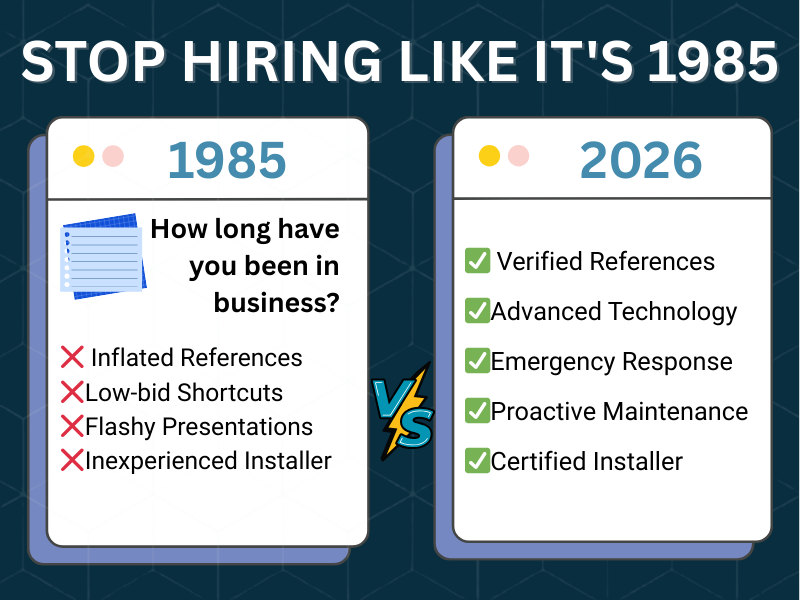
Stop Hiring Like It's 1985
Don't hire a commercial roofing contractor by asking “How long have you been in business?” That surface level question reveals almost nothing about whether your roof will last 10 years or 30.
The bigger the building, the deeper the research. We're super glad we came up on your radar. That's because we've been diligently helping by clarifying for a while.
But first, let's cover a couple negative techniques contractors use to game the system. You need to think beyond the obvious. A wise decision maker exercises wisdom.
The Data You Need To Know
1) 75 to 80% of construction defect disputes involve roof failures. But most failures aren't the materials, they're the installation.
Poor installation causes leaks, separation at seams, improper flashing, and roof blow offs. Experience installing expired materials with bad habits for decades doesn't equal quality workmanship.
2) The average American worker is productive only 4 hours and 12 minutes per 8-hour shift, meaning labor transparency matters more than total project hours.
You're paying for 8 hours but getting about 3.5 hours of focused work. That's why crew motivation, diligence, and proper pay structure matter more than cheap labor.
3) Commercial roofing net margins should be 8 to 15% after all expenses, anything below 8% means you're not their priority.
When you squeeze a contractor down to 6 to 7% true net, they'll ghost your project for higher margin work. They won't show up. You're creating your own nightmare by demanding unrealistic pricing.
4) “Going skinny to win” contractors low ball bids by 10 to 15%, then recover through change orders, with contract language buried on page 6.
They quote you cheap to secure the ink, then hit you with “unexpected” expenses within days. Read the fine print. “Estimates are subject to 10 to 15% adjustment due to market fluctuations.”
5) The 10% material drop territory claim. Pallets sitting in parking lots for months after deposit.
Some contractors drop about 10% of necessary materials on site just to claim they've “started”, then delay installation for several months, especially as fall turns to winter. Material drop doesn't mean work has begun.
6) Conklin's material claim rate is less than 0.5% since 1977, proving roof failures are almost never the product itself.
When modern materials fail, it's human error at seams, around roof equipment, perimeter, and corners. Research the actual factory rating of materials, don't just trust the contractor's supply lines.
7) The #1 complaint in commercial roofing Google reviews is communication breakdown. Promises broken, timelines stretched, avoiding conversations.
Not answering phones. Ghosting for days. Broken promises. Timelines that stretch weeks into months. This isn't about materials or pricing, it's about whether they'll actually follow through.
Why 40 Years Means Nothing
Most people don't have great evaluation skills. They overestimate their power to discern a best fit contractor for the project. Human nature gets super fascinated and fixated on just one thing, and one thing only. That magic word is experience.
Experience carries more weight than actual cost of installation in most people's minds. It's number one by far. Whoever has the most experience wins, right?
Wrong.
Experience Can Be Inflated or Undervalued
Experience alone does not equal wisdom. Wisdom is a completely different thing. Experience can mean “I use old materials the old way with bad habits for several decades.” Just because somebody's been doing something for a long time absolutely does not imply that they are the most skilled technician.
For example, people in our market are still installing materials that should have expired in the 80s and 90s. It's now 2026 and these old school roofers refuse to install liquids. They won't go get trained on acrylics or urethane. They refuse to install vinyl because it would require them to give up their old supply lines.
Their warehouses are full of rubber and plastic material, so guess what? They keep training guys on installing what's easy. What's convenient. Is that right for the client? No it's not.
Installing plastic (TPO) is cheap. Anyone can install plastic wrap. It doesn't take a whole lot of brilliance. But TPO plastic does not endure as long as vinyl. Vinyl is significantly superior for several reasons, which we explain at ModernRoofChemistry.com. Fire resistance, grease resistance, acid rain resistance, chemical resistance, foot traffic durability, UV resistance, vinyl is the future and plastic wrap continues to lose.
What to Look for Instead of Experience
A person who is properly motivated and properly trained can install today's modern material without having done roofing for three decades. A lot of our installers have been in the construction trades for decades. If the only thing a guy can do is put together a roof, that should be a yellow flag.
The installers should be multifaceted skilled problem solvers. When they come to an angle or a wall or something unique, they don't freak out. They don't cut corners. They don't hide in pride.
Of course the installer should be certified. They should go through factory training. They should have hands on experience. But we're looking for more than just a simple experience. You've hired people before based upon their resume. Not everything on a resume reveals who the person is, what motivates them, their actual work ethic. All that comes into play based upon their performance.
Modern Materials VS Expired Technology
Don't be afraid of acrylic. Don't be scared to investigate urethane. Don't freak out because somebody starts talking about PVC vinyl when all your life all you're aware of is that tar goes on roofs. It's called torch-down. Just like grandpa did. Or you put on a rubber roof. Or now you put on a plastic roof.
All of those are ancient, outdated, expired modalities that have been done for at least two decades.
At least two decades ago, superior technology was proven. Here's the trouble, Engineers, structural engineers, building engineers who write the codes or the blueprints for the requested material, graduated 20 years ago from school. When they graduated, TPO was all the rage.
Well, TPO has run its course and proven its worth in the marketplace. There are two prices to consider, there's the sweet-and-low price of today, and then there's the long term actual cost of ownership.
Only a fool would focus on one number while ignoring the other. That's like buying a work truck because it's cheap, while failing to check if this particular model has a bad reputation for being a high maintenance headache during the first 10 to 20 years. Why purchase a cheap ongoing problem?
Consider the price today balanced with the cost through the years. Both numbers matter. That's your job, to evaluate the options.
Make Time Your Friend
Your reputation for saving a couple dollars today is not going to be your reputation in the future. If you always only shop for tools at Harbor Freight, eventually it's going to bite you. Your maintenance department is going to stop sending you thank you notes.
YouReapWhatYouCheap.com — The sweet taste today of low price quickly fades into the bitter taste of heavy long term ownership. See the future.
Pick the product that's actually the least amount of headache down the road.
Installation Error VS Material Defect
It's easy to compare products. Comparing materials means looking at lab charts and third party testing data. But here's what most building owners don't realize.
75 to 80% of all construction defect disputes are related to roof failures, but the vast majority aren't from the product itself. They're from human error in sealing the seams, using the right sealant around roof equipment, perimeter, and corners.
Human error is far more likely the cause of roof issues than material defect. Conklin's material claim rate since 1977 is less than 0.5%, that means less than half of one percent of the time was there actually a material defect.
Don't Be Nervous to Get a Guarantee, and Read It
Give the guarantee to your lawyer. Have them look it over. Make sure it doesn't have 12 loopholes. The average commercial roof warranty is written by the installer's legal team as boilerplate to protect the installer. It's not built to actually provide protection primarily for the client.
You have to read through and find and plug at least half of the loopholes in the first offer of their warranty. Consider that you're building a relationship with a company based upon your perception of their reputation.
Their reputation cannot be entirely based on online reviews. You have to use your instincts. Yes, of course the salesman needs to know their product. But I would ask to meet the head of the installers. I would say, “Can you have your installer team come out and meet us? Or can I go visit a job site?”
We have a whole website dedicated to finding the 30 loopholes in commercial roofing warranties. Download our 30-point questionnaire for free at YourWarrantySaysWhat.com. Do the comparison. Save yourself much frustration. Or have your lawyer look it over side-by-side. Oranges to oranges.
The Labor Transparency Test
The skill of the crew matters significantly more than most building owners realize. Keep in mind we're in a sensitive climate right now with immigration and labor practices.
If the contractor won't be transparent enough to tell you what they're paying their workers, that's a yellow flag.
Pay Rates Matter, Here's Why
We're happy to itemize and show you that we pay between $22 to 28 an hour ranging based upon skill set and outputs. We're not looking for the absolute rock bottom cheapest non-driven low-grade laborers. We're not trying to cut corners when it comes to quality craftsmanship.
Neither are we trying to break up into the 30s or the 40s and pay union wages that would require us to add costs you don't need to bear.
We hire direct-pay W-2 workers, not outsourced. All of our workforce is able and authorized to work in America. If there's any hesitation when you talk to your contractor about whether they're subbing out part of the work or if they pay all their guys directly by W-2 and are they all authorized to work in America. That's gonna tell you if they're trying to source it out to cheap labor.
The Productivity Problem
There's a documented study showing the average American worker is only really focused and productive about 4 hours and 12 minutes out of every 8-hour shift. Some studies show as low as 2 hours and 53 minutes of actual productive time.
You're paying for 8 hours, but you're only getting 3 to 4 hours of focused labor. That's an industry-wide reality. So when you're evaluating contractors,
❌ You don't want a non motivated crew or a low motivation crew
🐌 You don't want a crew that stretches the job out week after week turning in inflated hours
⏱️ You want a balance of proper pay for proper results
✅ You want a guy that's gonna turn in a solid 8+ hours of high productivity, high focus labor within that 12-hour shift
Ask realistic questions like, “What's your motivation for working?” If the installer doesn't start talking about his five kids at home, his wife, his bills, how much he loves his craft, how he doesn't mind putting in 12 to 14 hour days when needed, then you know you have a slug.
You should be able to tell within three questions if a guy is going to inflate his hourly numbers and underperform. You should be able to interview and smell and discern whether someone has not just the skills but the proper motivation to follow through.
Transparency is the ticket. If you can't get a breakdown of actual raw material cost pass through directly from the wholesale supplier. If you can't get an itemization of how many hours, how many man-hours, and a schedule of what's gonna be accomplished on day one, what's gonna be accomplished on day two, and so on. If it's not broken down time-and-materials. That means these guys don't have the wisdom to project the actual timeline. That's a red flag.
Red Flags That Should Make You Walk Away
When you look at Google reviews for commercial roofing companies, the number one complaint is communication, or lack thereof. Promises broken. Timelines stretched. Avoiding conversations. Not delivering. Just not being upfront. Creates frustration.
Here are the red flags.
Red Flags (Walk Away Immediately) 🚩
🚩 10% material drop then ghost for months. Pallets sitting in rain and snow while no installation progress happens
🚩 "Going skinny to win" with change order ambush. Low ball bid followed by “unexpected” 10 to 15% increases buried in fine print
🚩 Won't itemize labor hours and materials. Refuses to break down time-and-materials or provide transparent pricing
🚩 Can't provide timeline breakdown. No schedule for day 1, day 2, etc. They don't know how to project actual timeline
🚩 Won't disclose worker pay rates or employment status. Hiding cheap illegal labor paid $15 to 20 cash instead of W-2 authorized workers
🚩 No modern material training or certification. 40-year roofer with zero hours of liquid coating training still installing 1990s plastic
🚩 Warranty full of loopholes and fluff language. Legal boilerplate designed to protect installer, not you
Yellow Flags (Proceed with Caution) 🟡
🟡 Won't let you meet the installation crew. You're hiring these people, you should meet them.
🟡 Can't explain why they DON'T use modern materials. Still pushing TPO plastic and EPDM rubber because their warehouse is full of it.
🟡 Only does one type of system. Rubber guy, plastic guy, tar guy. Not a solutions provider with full menu.
🟡 Pushes immediate decision without time to research. Pressure tactics mean they're not confident in their value.
🟡 Can't provide references or completed project photos. What are they hiding?
How To Weight Your Criteria
You need to look at your own emotions, your own intellect, your personality, and your choice patterns. How do you normally make these decisions?
This is fill-in-the-blank. You gotta put a number into every one of these lines. It's got to be YOUR number. Not something we suggest for you.
Think of the time when you didn't evaluate your own motives and you just kind of signed the check without fully processing all the data properly. Then think of the time when you did your homework and you felt secure and you made the right choice with another vendor or contractor. We're just trying to replicate that same scenario for you.
Here are the criteria to consider.
Imagine you have 100 coins. Or you have 100 points to play with. Don't spend them all on 3 categories.
Fill in a number per line, and your total equals 100.
______% Crew ethics, diligence, and motivation
______% Factory rating of material (lab data, fire tests, chemical resistance)
______% Warranty (actual legal protection after your lawyer plugs loopholes, not fluff)
______% Labor transparency (itemized hours, W-2 pay rates, timeline)
______% Product knowledge (modern liquid coatings vs expired plastic and rubber)
______% Communication and relationship track record (Google reviews, responsiveness)
______% True net margin health (8-15% realistic, below 8% means you're not priority)
______% Experience (yes it matters, but wisdom matters more)
Total must equal 100%.
Want to see how other smart executives responded to this poll? Fill in this contractor evaluation scorecard, and we'll show you the aggregate results from smart commercial building owners who've already done this exercise. Where should we send it?
Email it to me here: ______________
Regarding commercial property located at (enter address): ______________
Text me here : ______________ (optional)
A wise person knows you can't put 60% of your trust all in one bucket. That's way too easy. Your job is not easy. It's fun, but it's not easy.
Understanding The Economics, True Net Margins
You run a company. We run a company. All the contractors run a company. There are just hard costs, non negotiable. We all have to pay insurance. We all have to pay taxes. We all have to pay for office staff. We have to cover sales commissions. These are just solid numbers that add up.
Your true net take away in the commercial roofing space should be somewhere between 8% to 15% true net after all company operations expenses are met.
Just so you're aware, as you squeeze down lower on that true net number, you're only creating agitation and frustration on the part of the performer of the work.
If you try to squeeze a guy down to 6 to 7% true net, he's just not gonna show up. You are not his highest priority. He's gonna go find other projects. Why would somebody run such a massive operation with massive risk and overhead if they're not even taking home solid double digits?
The Three Buckets of Cost
There are three buckets in every commercial roofing project.
🧱 Materials. Don't skimp here. Garbage materials get garbage results. Research factory ratings, not just contractor supply lines.
👷 Labor. This is the most flexible bucket. Balance proper pay ($22-28/hr W-2) for proper results. You want focused productivity, not inflated hours from unmotivated crews.
🏢 Company Operations. Insurance, taxes, office staff, vehicles, licensing, certifications. These are fixed costs every legitimate contractor has to cover.
Your biggest leak is actually low grade labor or no motivation labor that stretches projects out week after week. That's where budgets explode. Not in the materials. Not in legitimate company operations. In the labor.
The Environmental Consideratonion
Some people really do care about the environment. They're rare, but they exist. Is this product good for the Earth? Am I having to tear off the old roof and throw it all at the local dump?
Can we do an overcoat or overlay, just add a fresh layer? Is it absolutely necessary to go all the way down to the decking?
Modern liquid coating systems allow you to restore and extend roof life without tearing off and dumping thousands of pounds of material. That's not just environmentally responsible, it's also significantly less expensive and less disruptive to your operations.
At Pristine Industrial Roofing, we give you the full menu. We put every option on the table.
Level 1: Patch and Repair. If we can patch it, everyone wins. Lowest cost. Sometimes a roof just needs targeted repairs.
Level 2: Liquid Coating System. Mid range investment. Thick urethane or silicone coatings create seamless waterproofing for 25 to 30 years.
Level 3: Overlay with Membrane. Add rigid walkable insulation plus membrane or coating. Improves insulation values for energy efficiency.
Level 4: Total Tear Off and Replacement. Worst case for totally rotted roofs. We don't try to go right to level four if it's unnecessary.
We assess your specific situation honestly. We're not trying to oversell or undersell. We're trying to give you the solution that makes sense for your building, your budget, and your timeline.
The Bottom Line
Choosing the right commercial roofing contractor for large buildings is NOT about who's been doing this the longest.
It's about wisdom. Motivation. Product knowledge. Labor transparency. Communication. Legal protection through proper warranties. And realistic profit margins that keep you as a priority client.
You came here asking how to choose the right contractor. The answer isn't found in comparing years of experience. The answer is understanding what modern solutions exist and which criteria actually matter for long term success.
Modern commercial roofing has evolved beyond plastic TPO and rubber EPDM. PVC vinyl membranes deliver 25 to 30 years of fire resistant, chemically resistant, puncture resistant protection. Liquid urethane coating systems create seamless waterproofing that lasts decades.
But don't take our word for it. Research the lab data. Check Google reviews for communication patterns. Demand transparency on labor. Have your lawyer review the warranty. Ask to meet the installation crew.
Your building is a significant investment. Your roof is its first line of defense. Make decisions based on data, not dated assumptions.
Ready to Make an Informed Decision?
Download the complete contractor evaluation scorecard with decision weighting framework, red flag checklist, and interview questions. See how other building owners weighted their criteria.
Where should we send your evaluation scorecard and comparison results?
Related Resources for Commercial Building Owners
For more information on protecting your commercial investment:
- YourWarrantySaysWhat.com — 30-point warranty loophole analysis and comparison tool
- ModernRoofChemistry.com — Lab testing data on vinyl vs plastic vs rubber materials
- Commercial Roofing Truths: Why Prevention Always Beats Procrastination
- Commercial Flat Roof Winter Damage and Prevention Tips

We Love Conversations
 SoHelpful@PristineIndustrialRoofing.com